Now that we have links to the Nelso.de site on Google Maps, German tourists to Prague should find the Nelso.de site more easily.
Tuesday, October 28, 2008
Google includes Nelso German-language data in Google Maps
We've been providing Google with data and photos for Google Maps in English and Czech for about a month, and we've now started providing them this data in German.
If you take a look at this search for Pizza Rialto in Prague, you'll see that the hours of operation are listed in German as well as, for some reason, Czech.
Now that we have links to the Nelso.de site on Google Maps, German tourists to Prague should find the Nelso.de site more easily.
Wednesday, October 15, 2008
Burger King in Prague?
It's been rumored for some time that Burger King would finally start opening restaurants in Prague, but a recent job posting looking for workers for a Burger King restaurant in the food court of Metropole Zlicin leads us to believe that the opening of the first Burger King in the Czech Republic will happen sooner rather than later. I personally can't wait. I've always liked Burger King more than McDonald's, and it's about time to have another burger chain in the Czech Republic (the only other international fast food chains in Prague are KFC and Subway Sandwiches).
Update: Burger King did finally open in Prague in early December 2008. You can find more info and a map here: Burger King at Metropole Zlicin.
Coffee to Go
When we started adding U.S. listings to the Nelso database, we added a number of new categories to the system. Some of these have been difficult to translate into all the other languages we support, especially Slavic languages like Polish and Czech. One category in particular has been impossible to translate into Czech: "Coffee Houses". The idea is that a "coffee house" is something different from a "cafe", in that a coffee house is more of a quick place to grab a coffee, and will often have only counter service. A cafe has waiters and a food menu, and is a place to sit for hours drinking coffee, smoking cigarettes, and talking with friends. The distinction is of course blurry (you could sit for hours in Starbucks writing the great American novel on your MacBook), but generally I think of a place like the Cafe Slavia in Prague as being quite different from a Caribou Coffee in Minneapolis.
Germanic languages like German (Kaffeehaus) and Danish (Kaffebar) do have good translations, but not so in Czech. So we've decided to take the easy route, and simply call these places "káva sebou" in Czech ("Coffee to go" in English). Perhaps the guys at Coffee in Town (a niche local search provider offering a guide to Prague cafes) can come up with a better translation for "coffee houses" on Nelso.
Thursday, October 9, 2008
Separated by a common language
England and America are two countries separated by a common language.We've finally taken the plunge and launched a Nelso site targeted at the United Kingdom at www.nelso.co.uk. We've owned the UK domain since the time of company's founding, but haven't activated it until now. We were prompted to do so because of the very low traffic we get from the U.K. despite the fact that Prague is a very popular place for Brits to get completely pissed in one of the city's many bars and clubs. We believe this is partially the result of Google preferring .co.uk domains when doing searches from the U.K.
--George Bernard Shaw
Speaking of "pissed" - where I come from (Minnesota), this adjective means "angry", not "drunk". Thus, we had to make a number of changes to the translation on the site, to convert it from American English to British English. "Pubs" become "public houses", "lawyers" become "solicitors", and so forth. We don't have any Brits on staff, so we'll have to run this translation by a native speaker to work out the kinks.
For more on the difference between UK and US English, you might want to check out M Lynne Murphy's blog, or try watching the UK and US versions of The Office back to back.
Thursday, October 2, 2008
Testing the GPS in the Nikon Coolpix P6000. Verdict: Good enough
About 24 hours ago, I finally received my Nikon Coolpix P6000, the first quality Nikon compact (i.e. "point and shoot") camera with built-in GPS. I was quite eager to test this camera, for reasons obviously related to Nelso's goal of collecting business data for most of the world's major cities. Over these 24 hours, I've used the in-camera GPS under a variety of conditions, and can report that the quality of the GPS, while not up to the standard of a high-end handheld unit like the Garmin 60CSx, is still very good, and more than satisfactory for most uses. This is just a test of the GPS inside the camera. If you want a full review of picture quality, RAW file formats, lens focal lengths, etc. it's best to wait until a site like dpreview.com or kenrockwell.com do a full write-up. Currently the camera is so new (even Flickr isn't tracking the P6000 yet) that no full-length reviews are available.
I'll jump right into the accuracy testing, and then will finish up with a few general comments about the GPS hardware.
Accuracy Tests
In all of the examples below, the marker labeled "A" marks the spot where the Nikon P6000 GPS thought I was standing or driving (more on shooting from a car below), and the marker labeled "B" indicates the correct position.Shooting from a position where you have a clear view of the sky
Below are photos I shot with the camera once I'd turned on the GPS and allowed it to get a strong signal from six satellites. Under these conditions, the error is approximately 3-10 meters (9-30 feet).
View Larger Map
View Larger Map
Shooting from a moving car
I was curious to see how the Nikon P6000 would perform when shooting from inside a moving car, where the GPS would have a limited view of the sky (I was in a minivan, not a convertible), but would still be able to track a few satellites through the windows. Despite having been in the car for more than 10 minutes (and thus not having a clear view of the sky for that time), the GPS performed remarkably well. The error was between 30 and 100 meters (90-300 feet) under these conditions.
View Larger Map
View Larger Map
Taking a photo after having just left a building
What happens when the camera has no view of the sky for a few minutes, and then is taken outside again? In this case, I left the camera inside for about 10 minutes, then went back outside. I let the camera get an initial track on a few satellites, but didn't give it the time it would need to track 4+ satellites and thus get a more accurate reading. This seems to me a reasonable test case, as many users will go inside a building for a while, and then come out and start shooting very soon after having a view of the sky.
View Larger Map
Performance was not bad (about 36 meters/110 feet off). In this case, it would have been more accurate to not have let the camera get a fix on my location at all, and have it fall back on its last recorded position (right before I entered the building on the right of the map above).
Shooting inside a building (i.e. no ability to track GPS at all)
In this case, I took a photo after having been inside a shopping mall in Prague for more than half an hour. Thus, there was no chance that the GPS in the camera could get a reading. What the camera did do was use the last valid GPS position that it had recorded before it lost satellite reception, placing me at the entrance to the mall itself. This seems to me a very satisfactory solution (more on this below).

View Larger Map
Other comments on the GPS in the Nikon P6000
It's very slow to get an initial positionWhen I took the camera out of the box and turned on the GPS, I actually thought the GPS in the camera might be broken. Even standing in the middle of a parking lot with a clear view of the sky, it took over 10 minutes for the camera to detect even the first satellite. While it's not unusual for a new GPS unit to take a while to get an initial fix on its position (the GPS has no idea even approximately of where it is; for all it knows, it might still be at the factory in Vietnam), an initial startup time of more than 10 minutes is excessive, and might lead other purchasers to believe as I did that the GPS is actually broken.
What's more disappointing is that the time to fix an initial position, after the camera has been off for a few hours, can still be 3-5 minutes depending on your view of the sky. I think some users will not pay enough attention to the GPS and will start shooting before the GPS has a chance to fix a position, leading to photos with no embedded GPS data.
Once you do get an initial fix on position, the camera updates its position data every 5 seconds, and this works well. If you switch to "GPS" mode on the camera (the display will then show a live update of your GPS coordinates as you move) it's clear that it tracks well. It's just that it'd be nice if, after leaving a building or turning on the unit in the morning, it wasn't necessary to stand out in a clear area for five minutes holding the camera up in the air before taking the first picture.
No "accuracy" info on the GPS display
Although the camera will show the location of satellites that it is tracking and your current coordinates on the display when in "GPS" mode, it is missing the all-important "accuracy" number. A dedicated Garmin GPS unit will not only show how many satellites it can see, but also an estimate of the accuracy of the coordinates that it is reporting. This is very useful when trying to determine if you are standing too close to a building, or under too much tree cover to get a good reading. The Nikon P6000 simply uses a three-segment display to show accuracy, and the third (best) segment seems to light up whenever accuracy is better than about 50 meters / 150 feet. This is not good enough. Hopefully a firmware update can add accuracy numbers to the GPS display, or at least add another few steps to the accuracy scale.
Writing GPS data to EXIF headers with no view of the sky
When you go inside a building, or any other area where GPS can not be used, the camera will use its last position to tag photos with location data. You can set the "time to live" of this GPS position data, which is very useful. How it works is this: you tell the camera the maximum age of the last point to use when tagging photos when it can't get a current fix on position. You can set this to anywhere from 15 seconds to two hours. Thus, if you have a "maximum validity" of one minute for GPS data, and you take a photo 30 seconds after losing contact with the satellites, you will get GPS data in the photo, but if you take a photo 90 seconds after losing contact with the satellites, you will not get GPS data in the photo. Assuming that a user sets this to something useful like 1-2 hours, this will be a great feature for tourists. You won't be able to track yourself as you move around the Louvre in Paris, but at least all your photos from your tour of that museum will be tagged with a location at the entrance to the building. Good enough.
You can set the date and time on your camera using GPS
You can set the time and date on your camera (but not the time zone) using the built-in GPS. This seems like an obvious thing for the software to support (of course, you never know; the iPhone still doesn't support cut-and-paste), but I'm still glad they included this feature. My experience with other Nikon cameras like the D40 is that the on-board clock is quite inaccurate.
What's the GPS chipset in this thing?
None of the spec sheets that I've come across were able to tell me what GPS chipset is used inside the P6000. Knowing this would have given me a better idea of what to expect in terms of accuracy. I guess we'll have to wait until someone takes one apart to find out.
Summary
I must say that I am quite pleased with the P6000, and that the accuracy of the GPS is easily good enough to make it useful. For most consumers, even accuracy of 100-200 meters will make looking through travel photos much more enjoyable (no more "Where was this shot?"). For our use, it will also work, assuming we take a few precautions to make sure we always get the best possible accuracy from the camera.However, if you want really accurate GPS data, especially in more demanding situations (very close to tall buildings, under extensive tree cover, inside a moving vehicle, etc.), the best route is still a camera paired with a dedicated GPS unit, either tethered directly to the camera, or recording your track to be synchronized with the photos later using an application like GPSPhotoLinker.
Thursday, September 25, 2008
Generic local business videos: will these work?
Local business directory site MerchantCircle has teamed up with Spotzer to offer small businesses semi-customized video ads. These ads are displayed alongside the company's details on the MerchantCircle site. You can see an example of these ads on this listing for Jump Palace in California.
Although we like the idea of offering businesses the ability to add videos to their business listings on the Nelso sites (check out this video for the Museum of Communism in Prague), we wonder if the generic videos that MerchantCircle is providing will be effective.
Take the case of the Jump Palace ad mentioned above. The entire text of the voiceover for the ad is "Looking for something a bit more entertaining?", and then the name and address of the company is shown on a black background for the last few seconds of the ad. What exactly this company does or why I should buy from them is not mentioned, because this ad was not made specifically for Jump Palace - they simply chose from a catalog of pre-prepared ads with generic voiceovers, and then added the company name to the end of the ad.
Will these work? Do users like video so much that they'll watch a video that really has nothing much to do with the company being advertised? Probably yes. We find it hard to believe that MerchantCircle and Spotzer would bother with these kinds of videos/ads if they didn't work. Users must like them for this campaign to make sense. According to MerchantCircle, more than 2,000 businesses have put together these generic business videos, so obviously businesses like them.
We find this very encouraging. We have started to offer businesses professionally produced, custom-made videos, and for the attractive price of free. If generic ads will appeal to consumers, then our custom produced, information-packed videos should perform even better.
Via Andrew Shotland of Local SEO Guide
Although we like the idea of offering businesses the ability to add videos to their business listings on the Nelso sites (check out this video for the Museum of Communism in Prague), we wonder if the generic videos that MerchantCircle is providing will be effective.
Take the case of the Jump Palace ad mentioned above. The entire text of the voiceover for the ad is "Looking for something a bit more entertaining?", and then the name and address of the company is shown on a black background for the last few seconds of the ad. What exactly this company does or why I should buy from them is not mentioned, because this ad was not made specifically for Jump Palace - they simply chose from a catalog of pre-prepared ads with generic voiceovers, and then added the company name to the end of the ad.
Will these work? Do users like video so much that they'll watch a video that really has nothing much to do with the company being advertised? Probably yes. We find it hard to believe that MerchantCircle and Spotzer would bother with these kinds of videos/ads if they didn't work. Users must like them for this campaign to make sense. According to MerchantCircle, more than 2,000 businesses have put together these generic business videos, so obviously businesses like them.
We find this very encouraging. We have started to offer businesses professionally produced, custom-made videos, and for the attractive price of free. If generic ads will appeal to consumers, then our custom produced, information-packed videos should perform even better.
Via Andrew Shotland of Local SEO Guide
Friday, September 19, 2008
Pizza in Paradise
Over the last few weeks, we've added 47,361 U.S. businesses to the Nelso database. Unlike our listings for Berlin or Prague, there is no rhyme or reason to these listings; in some cities like New York we have fairly comprehensive listings, and in other cities like Milwaukee, Wisconsin we have listings only for golf courses and pizzerias.
So what's the point? Why offer any listings at all if we can't offer the kind of comprehensive data that we offer in Prague?
We've added these listings as a sort of experiment. As any reader of this blog will know, the Nelso network of sites is the only local search network that offers all its listings in all the languages available on the site. So we wanted to add some U.S. listings to answer two questions:
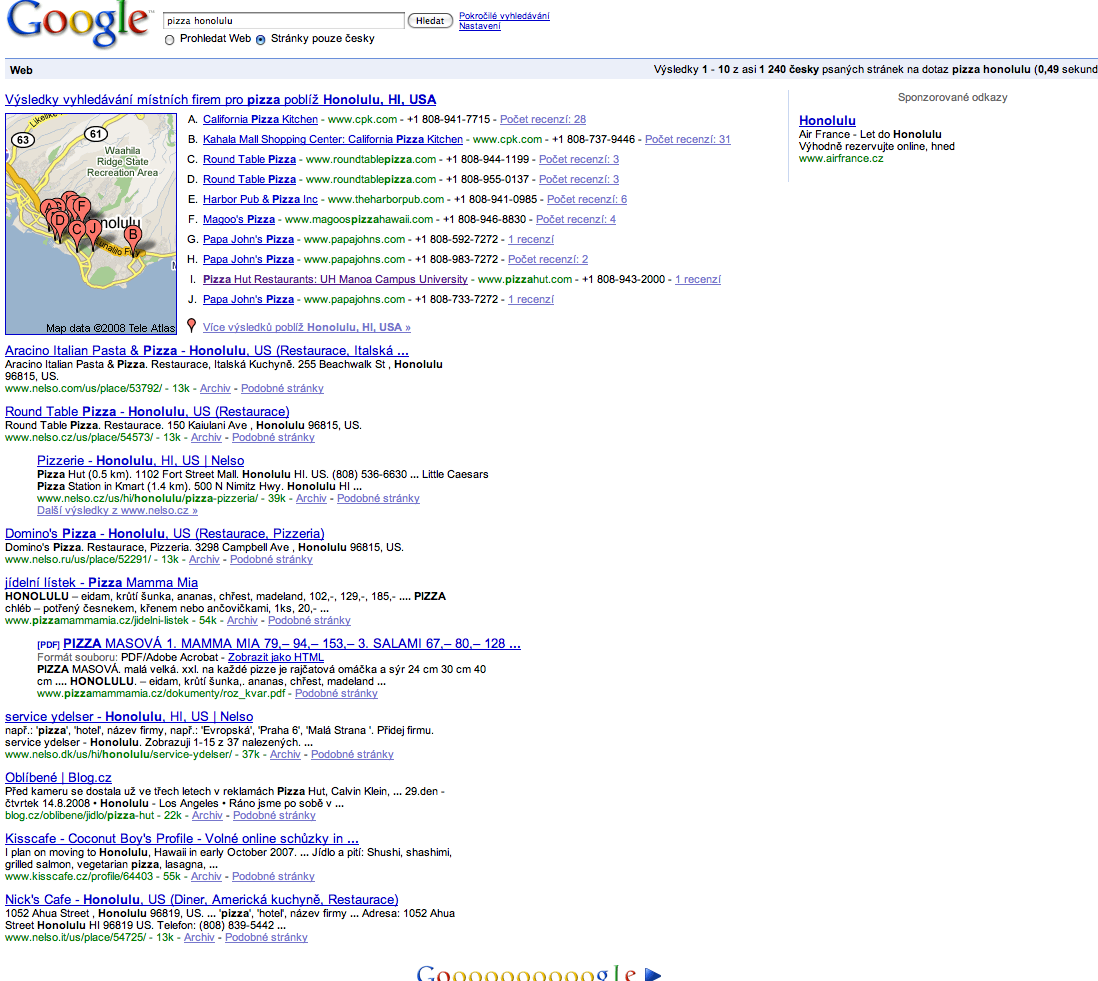
Well, I think we have an answer to question #1 (above): it is not terribly difficult to rank well for searches for U.S. businesses in languages other than English. A recent search for "Pizza Honolulu" on Google.cz brought up some rather astounding results: Nelso sites represented 6 of the first 10 results for this search (screenshot)! It'd be hard to achieve better ranking than that.
So what about question #2 (is this a big enough market)? We still don't have enough data to say conclusively if European travelers to the U.S. can justify the expense of developing comprehensive listings for U.S. cities. Our "gut feeling" is that this market is big enough. At Nelso, we define our addressable market as "All travelers that do not speak English as a first language". Seems like a pretty big market to us.
So what's the point? Why offer any listings at all if we can't offer the kind of comprehensive data that we offer in Prague?
We've added these listings as a sort of experiment. As any reader of this blog will know, the Nelso network of sites is the only local search network that offers all its listings in all the languages available on the site. So we wanted to add some U.S. listings to answer two questions:
- How easy is it to rank for searches for U.S. businesses in languages other than English? That is, how easy will it be to rank for the kinds of searches that a German, or Danish, or Czech tourist might do when traveling in the U.S.?
- If we can succeed in ranking for U.S.-travel related searches, is this a big enough market to care about? When a Danish speaker visits Chicago, does she even bother trying to search for information in Danish, or does she assume that no information will be available in her native language and start her searches in English (negating our advantage - it will be a long time before we can rank well for searches for U.S. businesses in English)?
Well, I think we have an answer to question #1 (above): it is not terribly difficult to rank well for searches for U.S. businesses in languages other than English. A recent search for "Pizza Honolulu" on Google.cz brought up some rather astounding results: Nelso sites represented 6 of the first 10 results for this search (screenshot)! It'd be hard to achieve better ranking than that.So what about question #2 (is this a big enough market)? We still don't have enough data to say conclusively if European travelers to the U.S. can justify the expense of developing comprehensive listings for U.S. cities. Our "gut feeling" is that this market is big enough. At Nelso, we define our addressable market as "All travelers that do not speak English as a first language". Seems like a pretty big market to us.
Second business video is up, for the Museum of Communism
We've completed production of our second business video, this time for the Museum of Communism in Prague. We'll be producing many more videos, but the format will be similar to this one and the one we produced for U Malého Glena.
Thursday, September 11, 2008
Testing, testing, 1,2,3...
We're going to start producing a series of videos about Prague (and later Copenhagen and Berlin) restaurants. Below is a test I did to see how the lavalier microphone was working. Video quality and sound quality seem OK, especially when using the clip-on microphone.
Monday, September 8, 2008
Oh, my beautiful URLs! Ruined!
Although we are using a number of SEO (Search Engine Optimization) strategies on the network of Nelso sites, one of the hardest to get right is "clean" or "pretty" URLs. There is some debate as to whether these kinds of URLs really help in terms of ranking on Google or Yahoo!, but in the interest of completeness we do try to keep the URLs on Nelso as "clean" as possible.
What is a clean URL? Well, it's an internet address that looks like http://www.nelso.com/cz/prague/cafe/ instead of http://www.nelso.com/search/?page=4&where=Praha&type_id=10. The idea is that it is easier for both humans and search engine spiders to see that the first URL is about cafes in Prague. The second URL ("places of type 10 in Prague") is more or less meaningless to both the GoogleBot and human beings.
So, what's the problem? Well, the above URL system worked fine when the site was entirely based on Prague, and worked well even when we expanded to a select number of cities in Denmark and Germany. The problem started when we decided to expand into smaller cities in both Europe and the United States. Take a look at this list of Czech cities (in Czech: "města"). Do you see what I see? Yes? The fact that the same city name is used as many as 10 times for different cities in the same country?
For example, take the case of the city of "Albrechtice". Our usual URL scheme of http://www.nelso.com/cz/albrechtice/ is not going to work in this case because "Albrechtice" is the name of nine different cities in the Czech Republic! There would be no way with the former URL scheme (e.g. http://www.nelso.cz/cz/albrechtice/) to tell exactly which "Albrechtice" the user wants.
To solve this, I've been forced to add a number identifier to the URL, so that the Kladno near Prague will have an URL like http://www.nelso.cz/cz/kladno-g3073699/ and the Kladno on the other side of the country will have an URL like http://www.nelso.cz/cz/kladno-g3073700/.
Not nearly as "pretty" as the former way of doing things at Nelso, but this is the only way this is going to work as we move out of major cities and into smaller cities. The one exception will the be the U.S. - in the U.S., there are as far as I know no duplicate cities within a state, so we can still use nice URLs like http://www.nelso.cz/us/ny/new-york-city/ when referring to U.S. towns. Even in the non-U.S. URLs, we're still stuffing the city name in the URL, so hopefully this won't hurt our search engine rankings too much.
What is a clean URL? Well, it's an internet address that looks like http://www.nelso.com/cz/prague/cafe/ instead of http://www.nelso.com/search/?page=4&where=Praha&type_id=10. The idea is that it is easier for both humans and search engine spiders to see that the first URL is about cafes in Prague. The second URL ("places of type 10 in Prague") is more or less meaningless to both the GoogleBot and human beings.
So, what's the problem? Well, the above URL system worked fine when the site was entirely based on Prague, and worked well even when we expanded to a select number of cities in Denmark and Germany. The problem started when we decided to expand into smaller cities in both Europe and the United States. Take a look at this list of Czech cities (in Czech: "města"). Do you see what I see? Yes? The fact that the same city name is used as many as 10 times for different cities in the same country?
For example, take the case of the city of "Albrechtice". Our usual URL scheme of http://www.nelso.com/cz/albrechtice/ is not going to work in this case because "Albrechtice" is the name of nine different cities in the Czech Republic! There would be no way with the former URL scheme (e.g. http://www.nelso.cz/cz/albrechtice/) to tell exactly which "Albrechtice" the user wants.
To solve this, I've been forced to add a number identifier to the URL, so that the Kladno near Prague will have an URL like http://www.nelso.cz/cz/kladno-g3073699/ and the Kladno on the other side of the country will have an URL like http://www.nelso.cz/cz/kladno-g3073700/.
Not nearly as "pretty" as the former way of doing things at Nelso, but this is the only way this is going to work as we move out of major cities and into smaller cities. The one exception will the be the U.S. - in the U.S., there are as far as I know no duplicate cities within a state, so we can still use nice URLs like http://www.nelso.cz/us/ny/new-york-city/ when referring to U.S. towns. Even in the non-U.S. URLs, we're still stuffing the city name in the URL, so hopefully this won't hurt our search engine rankings too much.
Subscribe to:
Posts (Atom)
![Reblog this post [with Zemanta]](http://img.zemanta.com/reblog_e.png?x-id=410b36d7-0825-4a6f-8f27-d993a20ee2a3)